
Published: Jul 22, 2026
Today began with a tour of both the French and Dutch sides of St Martin / Sint Maarten. We started at Orient Bay Beach, where we relaxed for an hour on the white sand, smoothies in hand. The next two stops were viewpoints: one looking over Oyster Pond, which is shared by both sides, and the other at the Rotary Lookout Point. We also passed Grand Case, a fishing village, before stopping in Marigot – the French capital – for an hour. We wandered around the open-air markets and ate the most delicious veggie Caribbean food, consisting of plantains, rice and beans, slaw, salad, and lentil stew. While the cruise food is something I’ll keep raving about, it’s nice to eat locally and experience some new flavours.


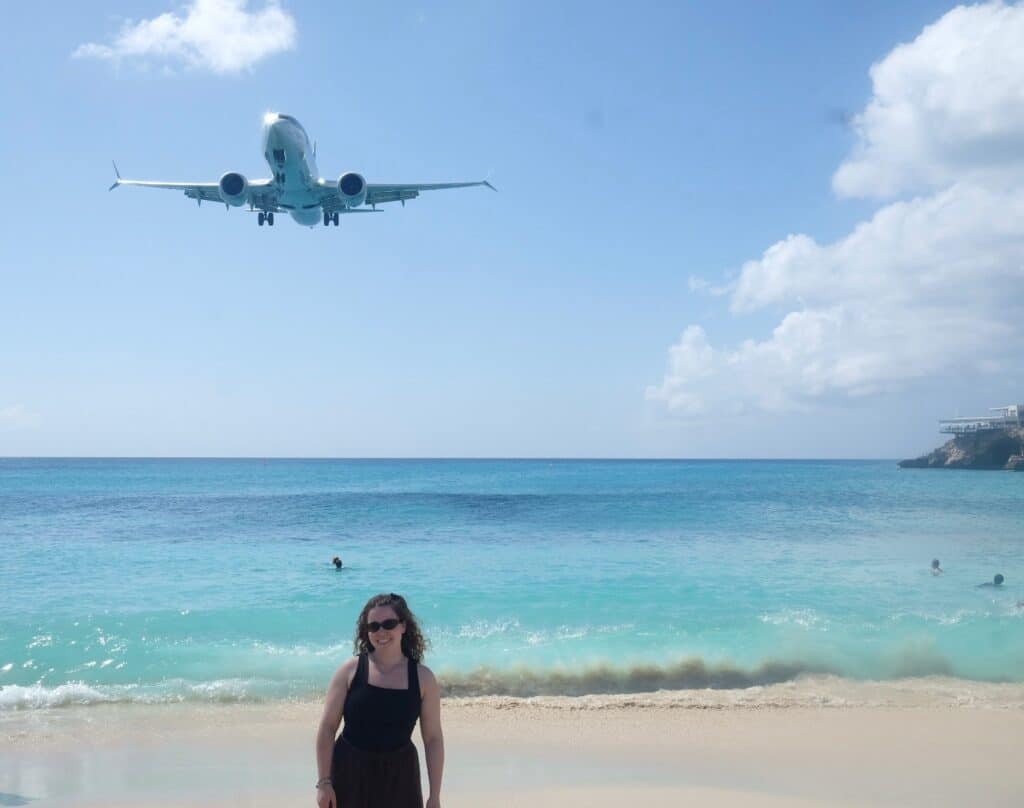
Next up, the famous Maho Beach! This experience was remarkable! We watched planes landing just a few feet above our heads – it was super thrilling, loud, and a little scary. Something about watching the planes in the distance and knowing they’d be skimming the air above us in just a few moments felt pretty addictive. Thankfully, we given extensive instructions by our tour guide beforehand on where to stand so as to avoid a face full of jet blast – very helpful. This really felt like a unique highlight of the day.

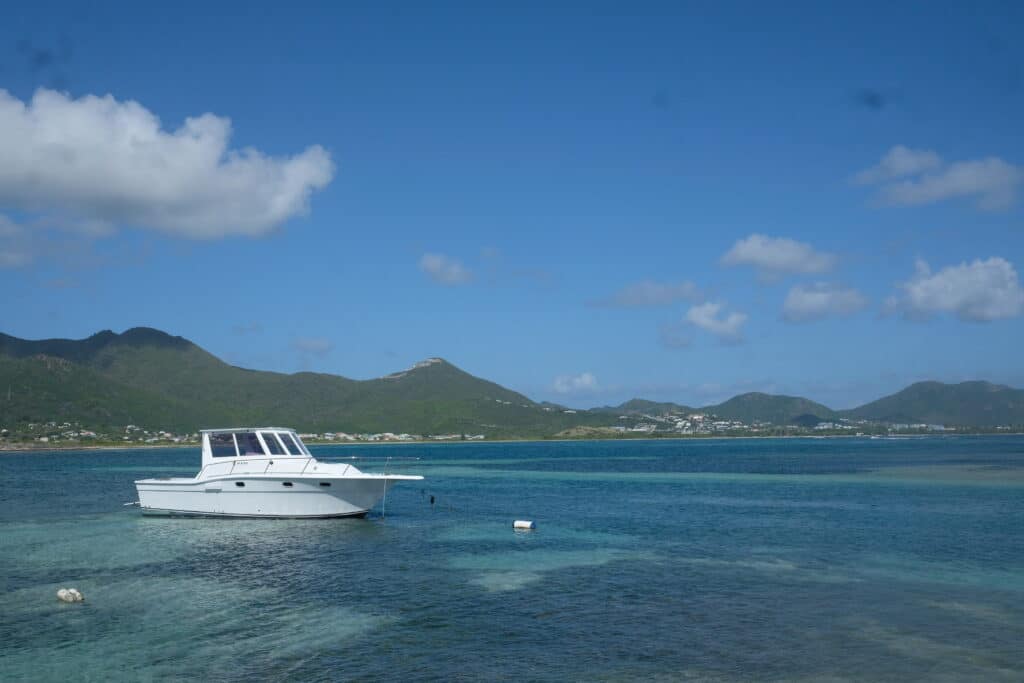
More lookout points for the rest of the tour – we passed Little Bay and Cole Bay Lookout, offering spectacular panoramic views. Beforehand, we passed the border monument, a symbol of the peaceful coexistence between the two nations. We ended our tour in Philipsburg – the Dutch capital.
As well as taking us to all the hotspots on both sides of the island, the tour was also very informative. We learned about the uniqueness of the island – how special it is that it has one of the oldest continuous international borders in the world and the oldest free movement treaties between that border. It’s a really rare case of peaceful, everyday transnational living, and with all the division and polarisation going on in the world right now, it feels like a fascinating study of how borders and identities can coexist in a way that actually works. Our guide told us that ‘everybody gets along’ here, which was such a nice thing to hear.
We also learned, and saw for ourselves, the differences and similarities between the two sides of the island. The French side is more traditional and European, whereas the Dutch side is more modern. Some people have their front yards belonging to the Dutch side and their back gardens belonging to the French side (or vice versa)! Administration rules, education, and prices change depending on the country, sometimes within minutes of walking. Something that’s true of the whole island though, is its lack of suitability for growing crops; the soil simply isn’t as fertile as other islands, and so most food is imported from sister islands. All of this was so interesting to learn about from someone who had lived here for 30+ years.
The medicinal benefits of Caribbean fruits, such as soursop, were talked about at length, too. As was the devastating Hurricane Irma in 2017, which was one of the strongest hurricanes in the Atlantic and hit St Martin / Sint Maarten directly. The tour guide talked about what it was like to experience the hurricane first-hand, and his experience of the island’s recovery since then. On a different note, the guide also mentioned the seaweed problem affecting parts of the Caribbean. Significant quantities of a type of seaweed called sargassum have been washed up on beaches in recent years, sometimes overwhelming popular shorelines and affecting tourism – particularly because of the strong rotten-egg-like smell it emits. We saw for ourselves just how prevalent it was along parts of the coastline.
The one thing that wasn’t talked about, fascinatingly, was slavery. The tour guide dedicated some time to mentioning the indigenous peoples of the island – the Arawaks and the Caribs – which I appreciated as that’s something I haven’t seen discussed very much during the trip so far. But he didn’t really talk about the slave trade. When I asked him whether the island’s infertile land had impacted the development of the slave trade, he responded in the affirmative, saying that slavery wasn’t really a thing on St Martin / Sint Maarten because sugar plantations weren’t possible.
This sounded peculiar to me, and I wondered whether the guide might have been simplifying a complex history for the purposes of a short tour. My curiosity grew when my partner and I headed out on our own afterwards to the Sint Maarten National Heritage Museum. There, we learned that the island was in fact very much impacted by the slave trade, and that two separate abolition decrees occurred on the French and Dutch sides. (We even saw the literal number of enslaved people on the island over the course of some years – it definitely wasn’t nothing…)
Having already found myself questioning how slavery was presented at St Nicholas Abbey earlier in the trip, I now have a new curiosity about why slavery is sometimes spoken about by locals in what feels like a somewhat distant or matter-of-fact way. I don’t have any firm conclusions about this, and I’m conscious not to assume too much from a short visit – I may well be wrong. It’s simply something I’ve noticed across several islands, and it rather feels like the opposite of what I expected.
After the museum, we spent some long hours on Great Bay Beach. I looked for shells in the white sand, tried to take advantage of the calm waters by getting some laps in but emerged defeatedly with a mild sting of some sort on my arm – alas, no cardio for me today – and simply relished in the fact that we were getting some uninterrupted beach time. Then, a tired walk back to the cruise, followed by dinner and a late night pub quiz on deck (9:30 pm, which is a late night by my standards on this holiday).
St Martin / Sint Maarten has been incredible today. It’s up there with St Kitts and Nevis as a favourite. I’ve absolutely loved this unique binational island, which I feel has an important message for the rest of the world, and I think that today has possibly been our most comprehensive in terms of touring and learning. Now for a well-earned sleep before we tackle Tortola on our own tomorrow!


